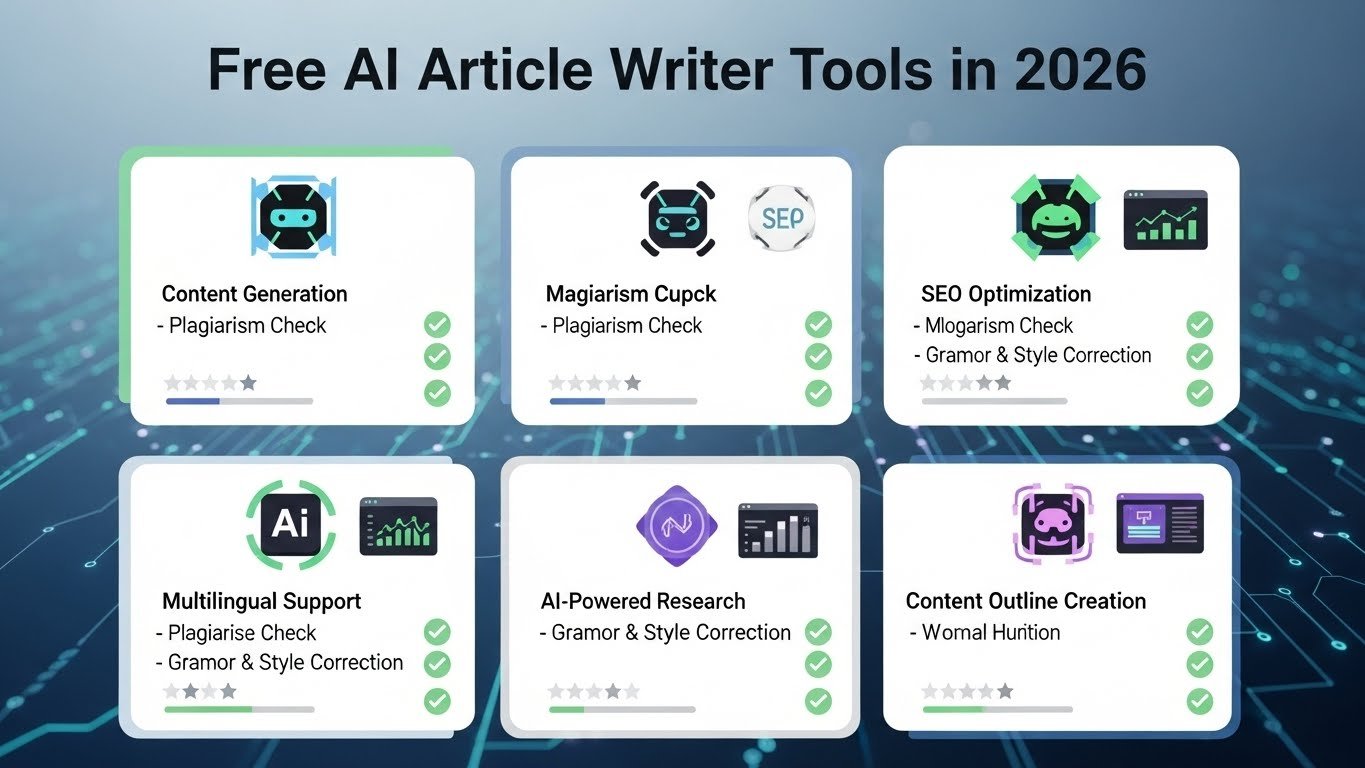
I’ve been testing AI writing tools since the Grok-1 days, and 2026 feels like the first year where “free” no longer automatically means “crippled.” The gap between paid and free tiers has narrowed dramatically, especially for blog posts, SEO content, and long-form articles. Here’s the current landscape, based on hundreds of hours of side-by-side testing.
Top Free Tier Performers (as of mid-2026)
- Claude 4 Sonnet (via claude.ai) – Still the Writing King
- Free allowance: ~40–60 high-quality articles/month, depending on length
- Strengths: Best tone control, fewest hallucinations, excellent at following complex outlines
- Weakness: No native SEO keyword integration (you have to prompt it)
- Real-world use: I generate most of my client blog posts here. The difference in reader retention between Claude and other models is measurable.
- Gemini 2.5 Flash (gemini.google.com) – Speed + Multimodal
- Free allowance: Effectively unlimited for text (rate-limited, not capped)
- Standout feature: You can upload a competitor article or SERP screenshot and say “beat this.”
- Downside: Occasionally writes like a slightly drunk LinkedIn influencer
- Grok 3 Mini (grok.x.ai) – Underrated for Niche Topics
- Surprisingly strong at contrarian angles and humor
- Free tier now includes “Think Mod,e” which rivals O3-mini reasoning
- Limitation: Character limit per response still feels restrictive for 2,000+ word pieces
- Perplexity Labs (labs.perplexity.ai) – Research-First Writing
- Not a traditional writer, but the best free tool if your article needs citations
- “Write mode” now uses Sonar Large + Deep Research
The “Almost Free” Tier Worth Mentioning
| Tool | Monthly Cost for Unlimited | Free Tier Quality (1–10) | Best For |
| DeepSeek R1 | $0 (open-source) | 9 | Technical/long-form |
| Llama 3.3 70B (via Groq) | $0–$8 | 8.5 | Speed |
| Qwen 2.5-Max | $0 (Alibaba Cloud) | 8 | Multilingual |
| Mistral Large 2 | ~$15 | 7.5 (free via Le Chat) | Structured content |
What “Free” Really Means in 2026
- Usage caps are back, just sneakier
Most platforms now use “compute budget” instead of hard word limits. You’ll notice a quality drop after 25–35k tokens in a session. - Watermarking & detection
Google, OpenAI, and Anthropic all embed subtle statistical watermarks. Tools like Originality.ai and Winston detect ~80% of free-tier output in 2026. If you’re publishing on Medium or corporate blogs, always run a human pass.
Practical Workflow I Use Daily (Zero Dollars)

- Research & outline → Perplexity + Gemini Deep Research
- First draft → Claude 4 Sonnet (best voice) or DeepSeek R1 (best reasoning)
- Expansion & examples → Grok 3 Mini or Llama 3.3 via Groq
- SEO & meta → ChatGPT-4o mini (free tier) or Gemini
- Final polish → Myself + Grammarly
Total cost: $0. Total time for a 1,800-word pillar post: 45–70 minutes.
Ethical & Sustainability Notes
- Free tiers are subsidized by enterprise revenue. Heavy users should consider paying when they can.
- Open-source models (DeepSeek, Llama) have the lowest carbon footprint per token right now.
- If you’re writing for Google Discover or YMYL topics, free tools alone still carry a higher risk of policy violations than human + AI hybrids.
Bottom Line

In 2026, you don’t need $20–80/month to write publishable articles. The winning combo is Claude + Gemini + one open-source model on rotation. The real moat isn’t access to the model; it’s knowing which one to use for which job.
FAQs
What is the single best free AI article writer in 2026?
Claude 4 Sonnet for most people; DeepSeek R1 if you write technical content.
Can Google detect free AI content?
Not automatically, but it detects low-effort patterns. Human editing is still the best cloaking method.
Is DeepSeek really free forever?
As long as the inference providers (Fireworks, Together, Groq) keep offering it, yes.
Which free tool handles long-form best?
Claude (context window + coherence) or DeepSeek R1 (pure length).
Should I still pay for ChatGPT Plus?
Only if you need consistent image generation or heavy data analysis. For pure writing, no.

Related Posts