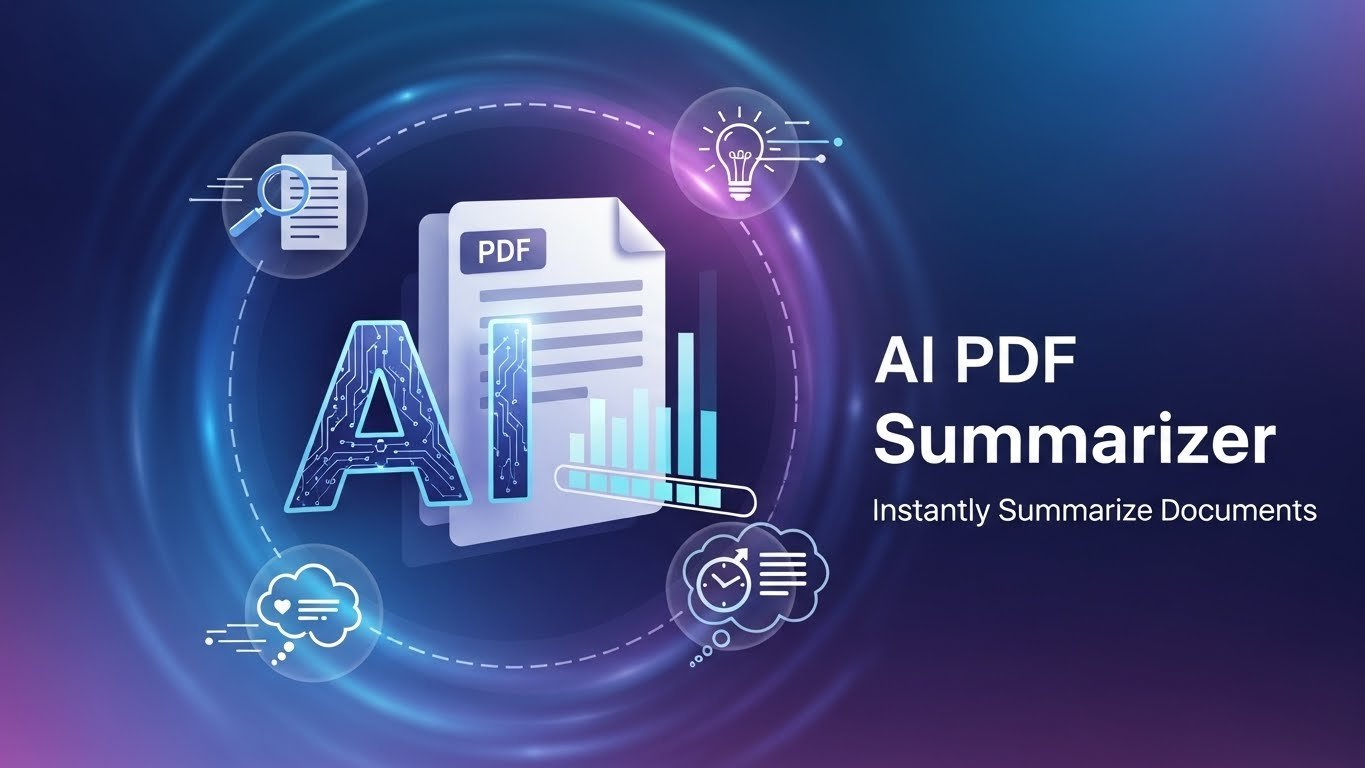
Last semester, I was tasked with compiling a literature review for my master’s thesis in environmental policy. My professor sent me a reading list of 28 peer-reviewed papers, each ranging from 15 to 40 pages long. I stared at the folder full of PDFs on my laptop, knowing that if I read every word cover to cover, I’d lose a full week of work that could be spent analyzing data and drafting my argument. That’s when I finally committed to using an AI PDF summarizer, a tool I’d hesitated to try because I worried it would oversimplify complex research. Three hours later, I had clear, concise summaries of every paper, complete with key findings, methodological notes, and policy implications. It didn’t just save me time; it let me focus on the work that actually mattered.
An AI PDF summarizer is a modern tool that uses advanced natural language processing (NLP) and large language models to distill long PDF documents into shorter, easy-to-digest briefs. Unlike the basic summarization tools I used as an undergrad, which simply pulled the first and last sentences of each paragraph to create a disjointed overview, today’s AI tools understand context. They can identify the core argument of a paper, separate supporting data from tangential examples, and even tailor the summary to your specific needs. For instance, I often ask the tool to only extract study limitations or policy recommendations when I’m compiling my literature reviews.
In my work as a freelance academic editor, these tools have become indispensable. I regularly work with graduate students and early-career researchers who send me dozens of source PDFs alongside their manuscripts. Instead of spending hours reading each source to verify that the researcher has accurately represented their findings, I use an AI PDF summarizer to get a quick overview. If the summary raises red flags like a key finding that doesn’t align with what the researcher wrote, I can dive deeper into the original document.
I’ve also seen these tools deliver value outside academia. A friend who runs a neighborhood café used an AI PDF summarizer to parse 12 local food industry trend reports last year. Instead of spending her weekend reading 200+ pages of data, she got 1-page briefs for each report, which helped her identify a growing demand for plant-based breakfast options and zero-waste packaging. She adjusted her menu and supplies within a month, and saw an 18% increase in weekend sales as a result.
That said, I’ve learned through experience that AI PDF summarizers are far from perfect. Last month, I tried to summarize a highly specialized paper about soil microbiome sequencing for a client. The AI completely misrepresented a key experiment because it couldn’t grasp the niche technical terminology used to describe the sequencing process. I had to go back to the original paper and rewrite the summary myself. These tools also struggle with scanned PDFs with low-quality optical character recognition (OCR), or documents that use complex formatting like tables and footnotes to convey critical information.
There are also important ethical and privacy considerations to keep in mind. Many free AI PDF summarizers store your uploaded documents and use the content to train their AI models. Last year, a colleague accidentally uploaded a confidential grant proposal to a free tool, and later found that snippets of the proposal were being used in AI-generated content shared on the platform. Always review a tool’s privacy policy before uploading sensitive documents. For copyrighted academic papers, it’s also important to note that while summarizing for personal use falls under fair use, uploading the full PDF to an AI platform may violate the journal’s terms of service.
When it comes to choosing the right tool, I recommend matching the tool to your use case. For academic work, Scholarcy is my go-to, as it is designed to extract citations, study limitations, and key findings. For general personal or small business use, ChatPDF offers a free tier for small documents, but I only use it for non-sensitive content. Adobe Acrobat’s built-in AI summarizer is a strong option for those who already use the software, as it keeps documents within a secure ecosystem. Most importantly, always test a tool with a document you already know well. If it misrepresents core details, it’s not worth using for high-stakes work.
At the end of the day, AI PDF summarizers are a tool, not a replacement for critical reading. For important decisions like writing a thesis, drafting a legal contract, or approving a major business investment, you should always verify the summary against the original document. But for sorting through a mountain of source material, quickly familiarizing yourself with a new topic, or cutting through the fluff in a long report, they are indispensable. I still read every high-priority paper cover to cover, but the AI summarizer lets me identify which papers are worth that deep dive in the first place.
FAQs About AI PDF Summarizers
- Are AI PDF summarizers free to use?
Most tools offer free tiers for small documents or a limited number of monthly summaries. Premium plans typically offer higher limits, better privacy protections, and specialized features for academic or business use. - Can AI PDF summarizers handle scanned PDFs?
Some tools can, but only if they have accurate OCR capabilities. Scanned PDFs with blurry text or distorted formatting will likely produce inaccurate summaries. - Is it safe to upload confidential documents to an AI PDF summarizer?
Only if the tool explicitly states that it does not store your documents or use them for AI training. Always review the privacy policy before uploading sensitive material. - Can I cite an AI PDF summary in academic work?
No. You should always cite the original document, and use the summary only as a tool to help you understand the source material faster. - Do AI PDF summarizers work for non-English documents?
Top tools support major languages like Spanish, French, and Mandarin, but accuracy may drop for less commonly spoken languages or highly technical content in non-English languages.

Related Posts