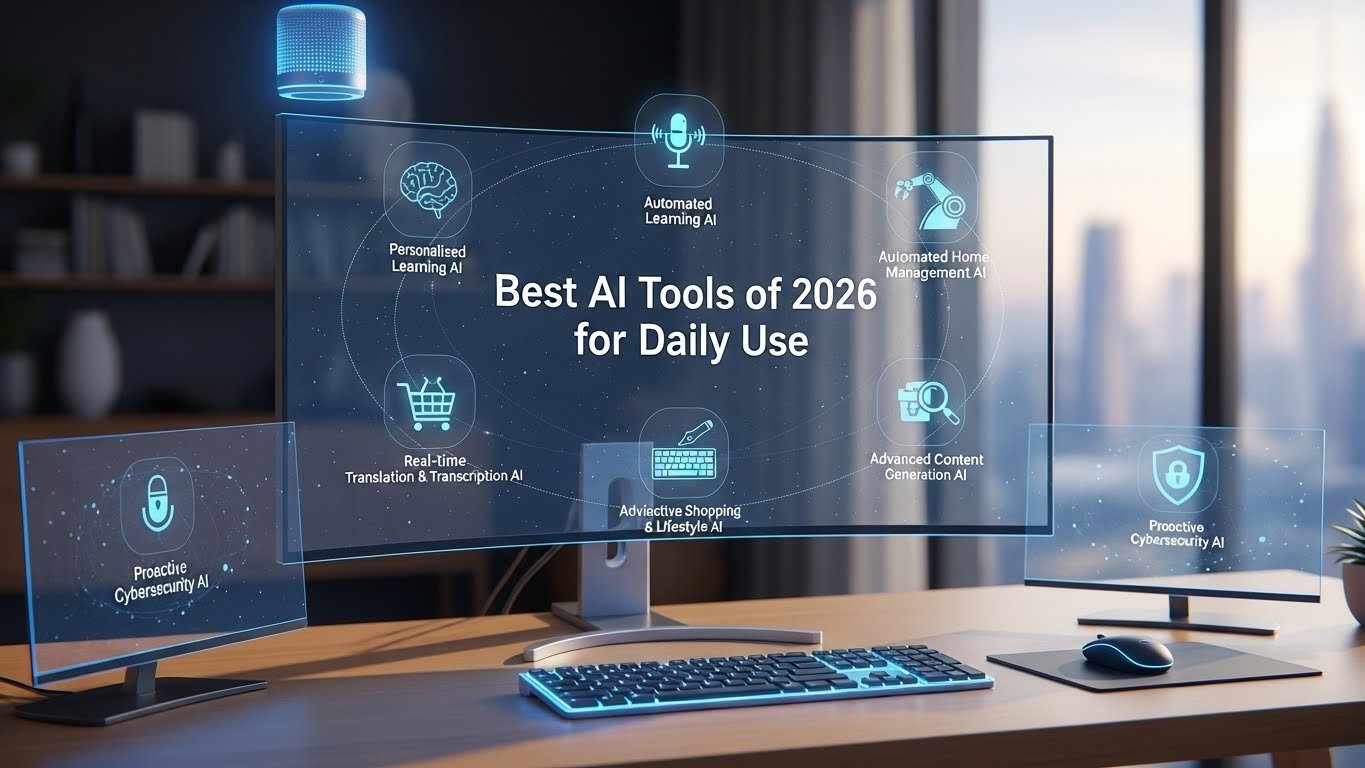
It seems as though only yesterday we were still astounded by the fact that AI can write an email that is passable, or create a slightly unrealistic image of an avocado-shaped armchair. Nowadays, it is like reading a flip phone. Change is not merely fast; it is accelerating in a manner that is radically changing our work, creativity, and even our a-ha moments.
Being a person who spends his days neck-deep in these technologies, testing them, breaking them, and making them a part of the real-life working process, I am often questioned, What next? The question is what will be required – the essential AI tool within two years?
I think the solution will not be one program or a brilliant new functionality. The idea of an independent “AI tool” will become a thing of the past by 2026. Rather, the ideal AI will be characterized by its ease of integration, autonomy, and less tool-like and more expert and specialized companion.
No more searching of the next viral image generator. These are the types of AI that will shape professional and creative life in 2026, depending on the trends we are currently experiencing.
- The Emergence of the Autonomous AI Agent: Your new Co-worker Specialist.
We are currently in the age of the co-pilot. We query an AI, and it provides us with an answer, which we perfect. It is a reactive conversation that is turn-taking. By the year 2026, we will be squarely in the era of the autonomous agent.
What’s the difference? A co-pilot is one of them, a friendly passenger who has a map. An agent is a colleague whom you can assign a project that involves multiple steps to.
Suppose that in 2026, this is the case with a small e-commerce business:
A manager will not analyze the sales data manually, write social media posts, and prepare ad campaigns, but will simply tell an AI agent: We have a 15% excess in our winter boot stock. Introduce a sprint sale-off among the former clients in cold regions. Allocate a budget of $2,000. Focus on platforms where our interaction had been the greatest last quarter. Provide me with a progress report after every 48 hours and automatically increase and decrease ad spend depending on the real-time conversion rates.
The agent will not simply do copy. It will:
- Check the inventory database in order to prove the numbers.
- Examine previous sales and CRM information to determine the target audience.
- Produce diverse ad images, video clips, and text, etc., rendered differently to suit the platforms.
- Connection to the APIs of Meta, Google, and TikTok to plan the campaigns and execute them.
- Keep track of performance, A/B test creatives, and redistribute the budget, without any additional human intervention.
- Prepare a succinct and graphic report and send it to the inbox.
Such agents will be specialized. You will have a marketing agent, legal discovery agent, software QA agent, and financial modeling agent. This is already starting to take shape with solutions such as a-engy, though in 2026, it is going to be much stronger, and more stable, and will be embedded into more foundational software in our daily lives, such as Salesforce, Microsoft 365, and Adobe Creative Cloud.
- The End-to-End Workflow: The Ultimate Coherent Creative Suite: Idea-Final Cut.
A splashy, multi-applied ball dance is the existing creative process. Our script is written in Google Docs, concept art is made in Midjourney, we find it difficult to maintain character consistency, we make a synthetic voiceover in ElevenLabs, and all of this is assembled in Adobe Premiere Pro. It’s powerful, but fragmented.
The walls between these modalities will collapse by 2026. Multimodal environments will be integrated as the best creative AI tools.
Imagine one platform in which you will begin with a simple textual challenge: “Make a 30-second animated short explainer video about photosynthesis to an audience of 5th graders, in the manner of a classic Pixar short.
The AI will generate:
- A clear and brief script that is age-specific.
- An illustrated comic strip (goodbye, six-fingered hands).
- All 3D animated scenes were adapted to the storyboard.
- A warm, jovial voice over, in total accord with the animation.
- It has a witty, gay, royalty-free music score, perfectly synced to the pace and mood of the video.
It is not the creation, but the control of the generation, which is the magic of magic itself. You will be able to play the role of a director, not that of a prompter. Maybe make the character sunflower appear happier in scene three. Please change the voice of the narrator into a female voice that speaks with a British accent. Is it possible to make the music more upbeat in the chorus? The platform will interpret and implement these high-level, contextual commands immediately, only regenerating the parts that are needed, and not the whole project. There are companies such as Runway and Pika that are moving towards this future, and by the year 2026, this will be the norm of creating content at a fast rate.
- Deep Analytics and Predictive Modeling: What to, Wh,y and What If.
Business intelligence tools are awesome at coming up with what has happened. The AI-based analytics of the year 2026 will be very good at justifying why it has occurred, more importantly, being able to predict what is likely to be next.
These will not be dashboards that have more beautiful charts. They will be sophisticated analytical machines capable of consuming and comprehending all the unstructured data of the company: customer support chat logs, Slack logs, company wikis, code bases, and sales call logs.
As an example, a product manager in the year 2026 will not simply have a chart of a decline in user engagement. They can query the AI, What has caused the number of people who use our mobile app every day to decline by 10 per cent in the last month.
The AI will compare reviews on the App Store, support tickets, and recent commits done by the developer to provide a synthesized knowledge: The drop includes the appearance of version number 3.5. Users complain of a 300 percent growth in login failures on the older Android devices, which also hit the roof in our Slack community. The problem appears to be connected to the new authentication library that has been introduced in commit number 8A2F5C.
This will make AI more of a strategic partner than a data visualizer. It links the dots that it may take a human team weeks to unify, so businesses can be proactive and not reactive.
“The human element isn’t fading; it’s evolving forward.!”
This vision may be dystopian, even intimidating. Does that imply that we will all be rendered jobless? I have a feeling of no, but I am sure our jobs will change. The finest AI applications of the year 2026 will be those machines that perform the tedious, repetitive, and computationally intensive work. This leaves us free to concentrate on what human beings are best at:
- Strategy and Goal-Setting: AI is able to implement a plan, yet it requires a person to specify the purpose and establish an endpoint.
- Taste and Judgment: AI can create an enormous amount of variants; however, it requires a creative director to select the one that will really hear.
- Empathy and Relationships: AI is able to compute the information about customers, but isn’t capable of establishing a trusting connection with an important client over lunch.
- Ethical Oversight: These systems will increasingly demand human-in-the-loop supervision to avoid bias, provide equity, and overcome still novel situations.
Code or data science will no longer be the most desired professional skill in 2026, but commanding and working with such strong AI agents. It will be the combination of critical thinking, creative problem solving, and what we may refer to as the art and science of whispering in the ear of AI, that is, the art and science of providing the correct instructions to achieve the intended results.
The future of AI is not a robot taking over you. It is a group of extremely strong, specialized partners, which will enhance your expertise if you are prepared to learn how to be the bandleader.
The most common questions (FAQs).
Q1: Will AI replace my job by 2026?
A: No, as most professional positions are concerned. More probably, it will reorganize your job to automate menial work, and you can concentrate on the upper-level strategy, creativity, and human-to-human interaction. Never consider replacement, think evolution.
Q2: Which do you consider the most important AI skill to acquire at present?
A: Successful immediate response and Artificial Intelligence communication. It implies that you should figure out how to provide clear, contextual, and multi-step instructions to an AI in order to achieve the complex outcome. It has to do with being a good filmmaker.
Q3: Can free AI tools be good enough?
A: Free and consumer-grade tools will be extremely strong for general labor. Nevertheless, in highly-skilled, high-consequence professional tasks (such as legal, medical, or advanced engineering) the most proficient ones will be highly-trained, safe, and probably subscription-based ones.
Q4: What is “multimodal AI”?
A: It is an artificial intelligence that is able to deduce, process, and create information in various forms or modalities. As an illustration, one can also use a text prompt to generate an image, examine an image to compose a description, or generate a video out of a script, all in a single system.
Q5: AIs and bias. Should I be afraid of AI ethics and bias?
A: Yes, it’s a critical concern. As a user, one should know that AI models may be biased in their training data. It will be a critical requirement as a professional to apply human supervision and scrutinize AI output, instead of just trusting it.

Related Posts