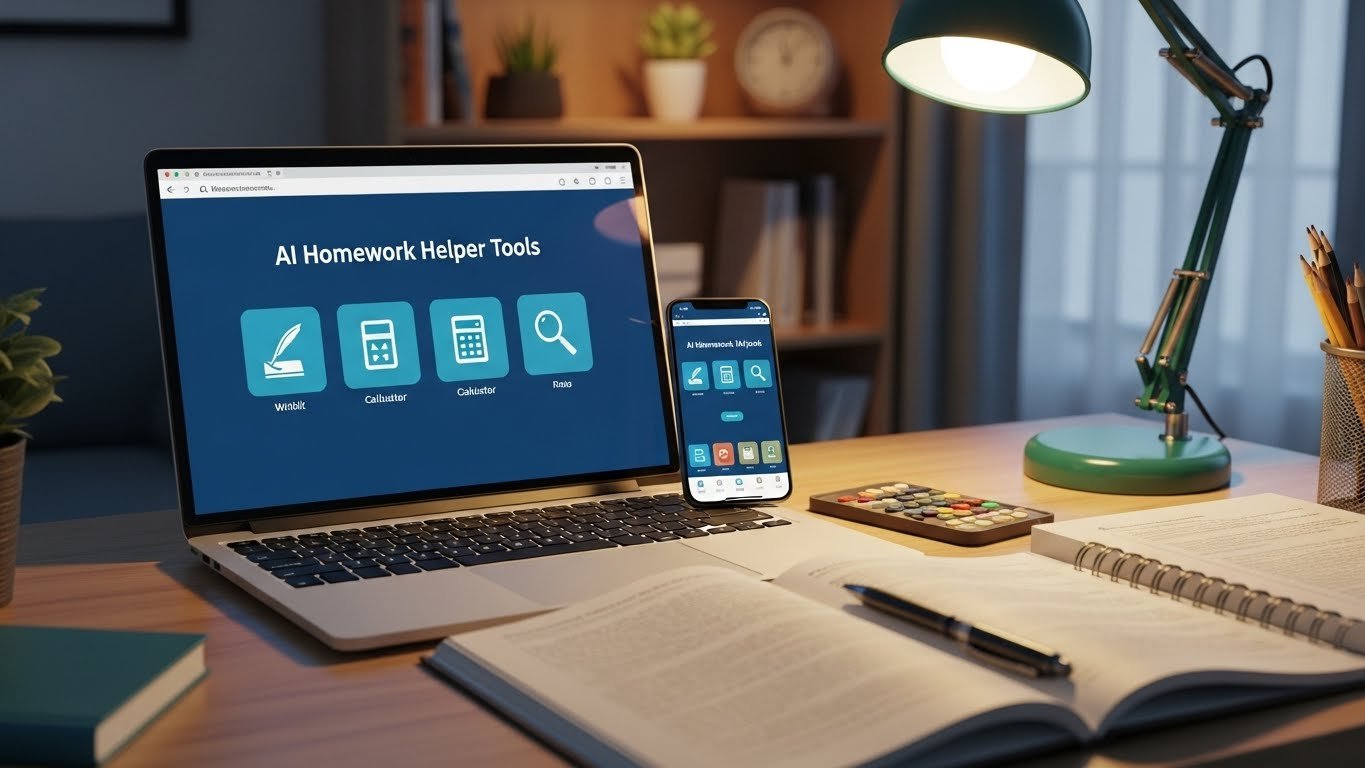
Over the past three years, I’ve watched the landscape of student study aids change faster than almost anything else in education. What started with basic math solvers like Photomath has exploded into full-spectrum AI homework helpers tools that can now draft essays, explain organic chemistry mechanisms, debug Python code, and even generate practice problems on demand.
As someone who has advised high school and college students, tutored privately, and occasionally collaborated with teachers on curriculum design, I’ve seen both the real benefits and the serious pitfalls of these tools firsthand.
The Main Players in 2025–2026
Here’s a quick snapshot of the most widely used AI homework assistants right now:
- ChatGPT (OpenAI) + GPT-4o / o1-preview – Still the general-purpose benchmark. Strong at writing, reasoning, and multi-step problems.
- Claude (Anthropic) – Claude 3.5 Sonnet and the newer 3.7 models often produce more thoughtful, less formulaic answers, especially for humanities and long-form writing.
- Gemini (Google) – Deep integration with Google Search and Docs; good for current events and research-heavy assignments.
- Perplexity AI – Search-first approach with clear source citations; popular for fact-based questions.
- Specialized tools
- Wolfram Alpha + Wolfram GPT → math, physics, and symbolic computation.
- Khanmigo (Khan Academy) → curriculum-aligned tutoring with guardrails.
- Socratic by Google (still active) → quick photo-based explanations.
- StudyFetch / Knowt / RevisionDojo → turn lecture slides or textbooks into flashcards and quizzes.
Real Benefits I’ve Observed

- On-demand explanations at any hour
A junior I worked with last semester was struggling with multivariable calculus chain rule applications at 11 p.m. Instead of waiting until office hours, she asked Claude to walk through a similar problem step by step. The next day she could solve the homework set independently. - Breaking down complex concepts
Many students tell me they finally “got” topics like acid-base equilibria or Shakespearean meter after seeing multiple analogies from different AIs. - Productivity for advanced learners
High-achieving students often use these tools to explore beyond the curriculum—simulating physics problems, prototyping small programs, or brainstorming thesis angles.
The Serious Downsides and Ethical Lines
Despite the upsides, the risks are real and increasingly documented.
- Over-reliance erodes learning
Brain research consistently shows that struggling productively (productive struggle) builds deeper neural connections. When students copy polished answers without engaging, retention suffers. A 2024 study from Stanford’s Graduate School of Education found that frequent use of generative AI for final answers correlated with lower performance on delayed tests. - Detection is getting better—and consequences are harsher
Most universities now use tools like Turnitin’s AI detection, GPTZero, and proprietary classifiers. Several large public universities (including UT Austin and the University of Michigan) updated their academic integrity codes in 2024 to explicitly address “unauthorized AI assistance.” - Hallucinations and subtle errors
Even frontier models still occasionally invent facts or make reasoning mistakes, especially on niche or very recent topics. I’ve seen students lose points because they trusted a confidently wrong explanation of, say, the 2023 Inflation Reduction Act tax credits.
Practical Ways Students Are Using These Tools Responsibly (What Actually Works)
From conversations with dozens of students who maintain high grades while using AI, a few patterns stand out:
- Use it as a tutor, not a ghostwriter
Prompt example: “Explain the difference between nucleophilic substitution SN1 and SN2 mechanisms, then give me a practice problem I can try myself.” - Ask for hints or step-by-step scaffolding rather than complete solutions
“I’m stuck on part (c) of this integral. What substitution should I consider first?” - Verify everything
Cross-check math answers with Wolfram Alpha or a textbook, and always trace citations back to original sources when doing research. - Leverage for metacognition
After finishing a problem, many strong students paste their own solution into the AI and ask: “Where could I have been more efficient?” or “What common mistakes do students make here?”
Institutional Responses (2025–2026 Trends)
- Some schools (e.g., certain Ivy League and UK Russell Group universities) now require students to disclose AI use in written work, similar to citing sources.
- Others provide official AI sandboxes (like Harvard’s “AI Sandbox” or Imperial College London’s controlled access to Claude).
- A growing number of teachers are redesigning assignments to be harder to outsource—think process portfolios, in-class writing, oral defenses, and personalized prompts.
Bottom Line
AI homework helpers are powerful amplifiers, but they’re not magic. Used thoughtfully, they can accelerate understanding and save time on routine tasks. Used as a shortcut for thinking, they can quietly undermine the very skills schools are trying to build.
The students who benefit most treat these tools like a very smart (but occasionally overconfident) study partner—someone you consult, challenge, and double-check, not someone you let do the work for you.
FAQs
Are AI homework tools cheating?
It depends on your school’s policy and how you use them. Copying full answers without understanding is almost always considered academic dishonesty. Using them for explanations or brainstorming is usually allowed unless explicitly prohibited.
Which AI is currently best for math and science homework?
As of early 2026, OpenAI’s o1-preview and Claude 3.5 Sonnet (with step-by-step reasoning enabled) tend to outperform others on complex multi-step math and physics problems.
Can teachers always detect AI use?
Not always, but detection accuracy continues to improve. More importantly, many educators now focus on designing assignments where rote AI output is obvious or unhelpful.
Are there free good options?
Yes ChatGPT (GPT-4o mini), Gemini, Perplexity, and Claude’s free tier are all capable for most high-school and early-college work. Paid tiers mainly add speed and higher usage limits.

Related Posts